builtonfacts.com
About the Author
I’m Matthew Murray Springer.
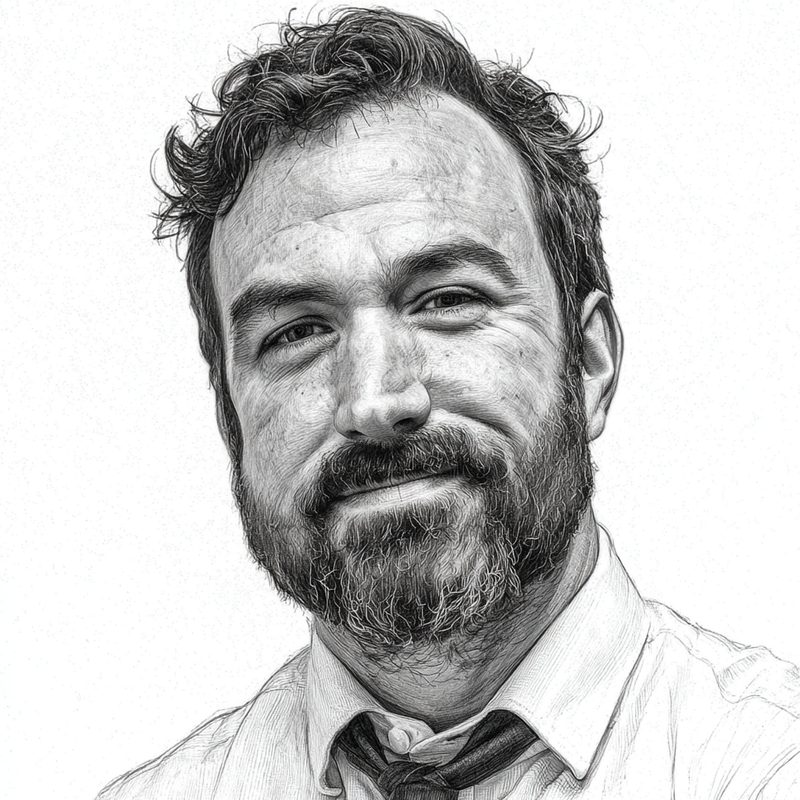
Readers may be less interested in my autobiography than they are in my writing. Some information about me may help you decide whether you’d find my writing worthwhile or congenial or at least plausibly accurate where facts are at issue. For this purpose I encourage you to consider the following biographical information about me.
I am a physicist. B.S. in Physics from Louisiana State University in 2007, and Ph.D. in Physics from Texas A&M University in 2013 with dissertation work on experimental ultrafast and nonlinear optics. To be clear I am not a working physicist, but physics never leaves one’s blood. I think like a physicist. While I like to think of myself as reasonably sharp, the plain fact of the matter is that I was never going to be in that elite stratum that revolutionizes our understanding and ends up having SI units or atomic phenomena or at least dignified institutions named after them. Nevertheless, I tremendously enjoyed my time as a worker bee in physics. I still get the urge to buy lab equipment and set it up in my basement.
I am an engineer. While physicists seek to understand how creation works, engineers seek to make human creations work. This is a fascinating, faster-moving, and frankly more profitable line of work. While I have never taken so much as a single engineering course, I have made a career in the aerospace industry as a general problem-solver for making various things work in air and space.
I am a Bayesian. Early in my engineering career I was faced with a problem involving sensor fusion and wanted to know more about how to combine probabilities. Not long into my poking through the literature I discovered the great E.T. Jaynes—like me, physicist with a particular fondness for light and matter. In the latter portion of his career he spent much of his time expounding the idea that probability theory was a generalized form of logic. Indeed, probability is provably the only way to generalize classical logic under uncertainty. We know that if Socrates is a man, and all men are mortal, then Socrates is mortal. But if a man is mortal, what are the chances that man is Socrates? For this kind of question, it’s probabilities that you need.
I am a family man. I am married, and I have kids. I care about this generation and the next. I hope to leave an inheritance in the broadest sense for my children and my children’s children. (I intend not to have much literal money left to leave them after my death. I’ll do my best to help my family while I’m alive and they’re young and they most need it.)
I am a Christian. Some of you may read that and perform a Bayesian update that docks me about 15 IQ points; nonetheless, if that describes you, I hope my writing revises your opinion in the opposite direction. I affirm the Nicene Creed. I expect that at some point the world will literally end in some eschatological way. The apocalypse is in secular vogue as well, so although we differ in the mechanism I think I’m in surprisingly broad company when I believe there’s some meaningful chance I’ll have the decidedly mixed fortune to die in the literal End of the World rather than the ordinary way of mortal flesh.
Matthew Springer