Essay
Can’t Stop, Won’t Stop
Zvi Mowshowitz of Don’t Worry About the Vase posted an interesting poll:
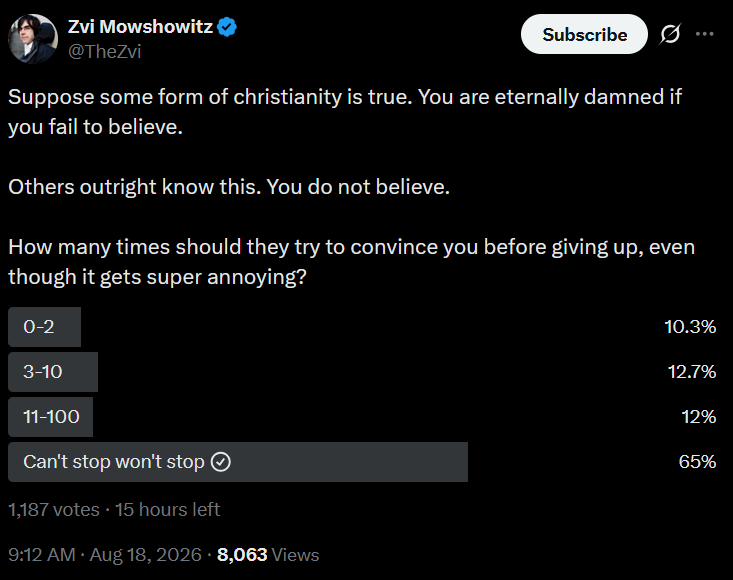
Now, Zvi is not asking about Christianity. He’s asking about AI x-risk. That is, if superintelligence is going to kill everyone if anyone builds it, how annoying are the believers in the not-so-good-news of Yudkowsky and Soares allowed to be?
It’s an interesting pair of questions. They have much the same answers.
Belief vs. Faith
Belief and faith are often regarded as synonyms. They’re not quite. Belief is the real number between 0 and 1 that you assign to the credibility of a definite proposition. Probability, in other words.
How likely is my favorite political party to control the U.S. Senate in November? How likely am I to be happy if I accept this job offer? Will it rain tomorrow? Will I win if I buy a lottery ticket? Was there ever life on Mars?
Is Jesus Christ the son of God?
Will sufficiently advanced AI end mankind?
Some of these questions have implications for your decision-making. If it will rain tomorrow, you might want to bring an umbrella. You don’t have to. You can risk getting wet if you’d like. Maybe you think rain is unlikely enough to risk it. Maybe you like getting rained on.
Belief is the probability; faith is the decision.
The eleventh chapter of Hebrews opens with a well-known verse:
Now faith is being sure of what we hope for, being convinced of what we do not see.
The chapter then goes on to list a large number of biblical figures and what they did, not just the bare fact of belief.
By faith Noah, when he was warned about things not yet seen, with reverent regard constructed an ark for the deliverance of his family.
An ark probably isn’t going to save you from being turned into paperclips if a superintelligence really wants to turn you into paperclips.
Noah’s faith was presumably buttressed by near-complete belief, but the Bible is full of people whose faith was a result of incomplete, inchoate, or ill-informed belief. One might think of Naaman the Syrian (2 Kings 5), the Centurion (Matthew 8:5–13), the Ethiopian eunuch (Acts 8:26–40), and others. Perhaps the most famous passage is Mark 9:14–27 where a desperate father pleads with Jesus for help for his son:
Jesus asked his father, “How long has this been happening to him?” And he said, “From childhood. It has often thrown him into fire or water to destroy him. But if you are able to do anything, have compassion on us and help us.” Then Jesus said to him, “‘If you are able?’ All things are possible for the one who believes.” Immediately the father of the boy cried out and said, “I believe; help my unbelief!”
The man wasn’t sure, but he acted anyway.
In the AI community, people like to talk about their p(doom), the probability that they assign to the possibility of some variety of severe catastrophe resulting from the continued development of AI. Even with the same degree of p(doom), people place their faith in very different courses of action. Paraphrased:
“There’s a 20% chance of doom. Let’s go for it! The benefits are worth the risk.” (Typical of people like Elon Musk)
“There’s a 20% chance of doom. Shut it down.” (Typical of people like Yoshua Bengio)
You might think there’s no chance of doom, or you might think doom is much more certain. (Eliezer Yudkowsky is around p(doom) = 99.5%, and unsurprisingly would like to shut it down.)
You need not be certain of Christ’s divinity to repent and be baptized.
You need not be certain of AI doom to say humanity should approach potential superintelligence with great caution.
Pascal’s Pensées
Do not, then, reprove for error those who have made a choice; for you know nothing about it. “No, but I blame them for having made, not this choice, but a choice; for again both he who chooses heads and he who chooses tails are equally at fault, they are both in the wrong. The true course is not to wager at all.”
Yes; but you must wager. It is not optional. You are embarked.
French physicist1 Blaise Pascal is sometimes criticized for Pascal’s Wager, a philosophical argument for Christian belief that supposedly (but not actually) runs as follows: “If God is real and you believe in him, you get an eternity of bliss. If God is not real and you believe in him, you’ve missed out on some debauched pleasures but lived a virtuous life anyway. So you should believe.”
If this argument sounds completely unconvincing, you’re not alone. What if there’s a God who punishes people who accept silly wagers? What if you believed in the Christian God, but actually Shaivism is true — and boy is Shiva mad?
You should be skeptical of this argument, but more so, you should be skeptical that Pascal of all people would have put forth such a poor argument in the first place.
What Pascal actually said, you should read for yourself. It’s simply this: if you are almost convinced, your belief balanced on the razor’s edge, you have to commit.
“I confess it, I admit it. But, still, is there no means of seeing the faces of the cards?”—Yes, Scripture and the rest, etc. “Yes, but I have my hands tied and my mouth closed; I am forced to wager, and am not free. I am not released, and am so made that I cannot believe. What, then, would you have me do?”
True. But at least learn your inability to believe, since reason brings you to this, and yet you cannot believe. Endeavour then to convince yourself, not by increase of proofs of God, but by the abatement of your passions. You would like to attain faith, and do not know the way; you would like to cure yourself of unbelief, and ask the remedy for it. Learn of those who have been bound like you, and who now stake all their possessions. These are people who know the way which you would follow, and who are cured of an ill of which you would be cured. Follow the way by which they began; by acting as if they believed, taking the holy water, having masses said, etc. Even this will naturally make you believe, and deaden your acuteness.—“But this is what I am afraid of.”—And why? What have you to lose?
Maybe the LLM is a dead end. Maybe Ed Zitron is right and the entire edifice will implode in a cloud of financial debris and depreciated silicon. Maybe the exponential will finally roll into a sigmoid and the hope and fear of superhuman intelligence will recede into the far future.
Maybe you’re 50/50. On one hand lies the ordinary march of normal technology and AI is a problem and opportunity of the kind humanity has eventually mastered ever since the first caveman thought maybe he could do something with that hot flickering light that makes the sticks black. On the other hand lies catastrophe.
It’s an inverse of the caricature of Pascal’s wager. If you slow the march of AI progress, the worst case scenario is that AI technology… marches a little slower. The best case is that you save the world.
There are those who embrace the wager in its caricatured form. They want to accelerate AI progress because they believe it can cure death. Nick Bostrom’s “The Fable of the Dragon-Tyrant” is typical. This viewpoint is worth its own essay; suffice it to say that I view it as stupendously unlikely.
How to Share
Despite the eternal significance of each person’s response to the gospel, in fact Christians have not generally practiced an evangelism based on overwhelming the lost souls of the world with an infinite barrage of street-corner sales pitches. When tried, those tactics have generally failed.
We’re obligated to share the gospel in honest and self-sacrificing ways, but each person’s response is between them and God.
Are we supposed to meet people where they are and share the good news effectively? Yes. (1 Corinthians 9:19–23)
Are we supposed to shake the dust off our feet when we’re clearly rejected? Yes. (Matthew 10:14)
Are we supposed to continue to keep the door open so that those who have rejected us have the opportunity to change their minds, if God so leads them? Yes. (2 Timothy 2:24–25)
For those worried about AI, they might write books, they might form research institutions, they might lobby their legislators.
Scoffers might ask why the AI-concerned aren’t suicide-bombing data centers. Christians can sympathize. “If you really believe it, why are you doing this deranged thing I imagine your religion requires?” Because you badly misunderstand everything about what we believe, possibly deliberately. We do not do evil that good may come of it (Romans 3:8), and frankly good won’t come of it anyway.
Annoyed to Death
You may say that if a Christian shares the good news and it’s rejected, well, so much the worse for that person. Everyone else is fine. But if superintelligence is built, there may be no survivors.
This is true. The atheist staring down this reality without God is accepting a grim truth in a dark and uncaring universe. Pascal again:
The eternal silence of these infinite spaces frightens me.
Our theological hope against that darkness is a power the atheist does not have. They may say it’s an illusory power. Such is life in an uncertain world. But you must wager.
Different though our hopes are, we’re not unused to giving dire warnings. The Bible is full of prophets saying “Please consider shaping up or you’re all going to die.” These prophets tend to get thrown into cisterns (Jeremiah 38:6) and then watch as everything they loved is destroyed. Jesus himself warned of destruction, was crucified, and the generation that saw his death saw the destruction of the temple and the scattering of the Jewish people.
Not everyone died, at least not at once, although it’s worth saying that regardless of the scale we regard death as the last enemy (1 Corinthians 15:26). We look forward to the resurrection of the dead and the life of the world to come. I don’t think Mowshowitz does. But he, like us, would prefer that our hated enemy not extinguish us all at once.
An Altar Call
If you’d like to know more about the message of Jesus, I suggest the third chapter of John’s gospel.
If you’d like to know more about the risks of superintelligence, I suggest MIRI’s short introduction.
I fully endorse the former. I don’t fully endorse the latter. My belief in the possibility of AI doom is not that high, certainly not nearly as high as that of MIRI. But faith? I have faith that caution is the right choice.
All Bible quotations from the NET Bible.
Matthew Springer
- Physicist, mathematician, philosopher, theologian, and (if you squint) engineer — Pascal is deservedly a hero of many disciplines. ↩